
Protein Stabilisation
Protein Stabilisation
The stabilisation of biological molecules is essential for commercialisation of products containing enzymes, antibodies, peptides, vaccines DNA and other unstable biomolecules. At Polygenyn we have over 20 years’ hands-on expertise in the long-term stabilisation of biological molecules. We have stabilised proteins both in the dry state and in solution. The current count being 35 different proteins or enzymes.
Currently we have over 20 publications relating to the stabilisation of proteins in multiple formats.
Our stabilisation technology has been used in disposable and reusable electrochemical biosensors in the medical and environmental sectors. Further applications include optical environmental monitoring and currently the stabilisation of LAMP assays for the detection of Plant DNA in fields of crop.
Protein Stabilisation Products & Services
The stabilisation of biological molecules is essential for commercialisation of products containing enzymes, antibodies, peptides, vaccines DNA and other unstable biomolecules. At Polygenyn we have over 20 years’ hands-on expertise in the long-term stabilisation of biological molecules. We have stabilised proteins both in the dry state and in solution.
Currently we have over 20 publications relating to the stabilisation of proteins in multiple formats.
Our stabilisation technology has been used in disposable and reusable electrochemical biosensors in the medical and environmental sectors. Further applications include optical environmental monitoring and the stabilisation of LAMP assays for the detection of plant DNA in fields of crop.
What do we do that’s different??

At Polygenyn we screen the stability of proteins at 4oC, 22oC and 37oC using an extensive panel of polymers, sugars, and polyalcohols. The screening process uses simple optical assays for the protein in question. By using microtitre plate assays we can quickly screen stabiliser formulations for compatibility with the protein being screened. We also screen the protein for pH and buffer compatibility which can prove to be crucial for the overall stability of proteins.
This first screening phase quickly identifies families of stabilisers with good protein compatibility and optimises pH and buffer compatibility. We also investigate compatibility with the final measurement system required for the final product. We have simple electrochemical methods that can be used for quickly screening the biochemistry on simple electrode designs. We have real time PCR equipment for screening PCR and LAMP reactions.
At the end of this set of preliminary tests we have a good idea what conditions are best for your protein.
This initial screening process will take us about 10 days. Using our simple screening process, we can identify a number of potential protein stabiliser molecules which will extend shelf life of your proteins.
Customised stabiliser kits (PGED):
We also provide customised protein stabiliser kits adjusted to customer requirements.

Read More
This kit contains 6 double strength stabiliser formulations designed to troubleshoot the stability of enzymes, antibodies, peptides and DNA molecules. These formulations can be scaled up to provide our customers with a reliable source of stabilisers for various applications. Customer specific kits can be developed for bespoke applications if required following consultation.
Antibody Stabilisers
Antibody stabiliser solution used for the stabilisation of polyclonal, monoclonal, conjugated antibodies and recombinant antibodies.
- (PG04) Antibody solution stabiliser. Data sheet
- (PG05) Antibody dry stabiliser. Data Sheet
Enzyme Stabilisers
Horseradish peroxidase (HRP) stabiliser
Stabiliser solution used for the stabilisation of HRP in the dry state.
- (PG06) HRP dry stabiliser. Data Sheet
Cholesterol esterase (CHE) stabiliser
Stabiliser solution used for the stabilisation of CHE.
- (PG07) CHE dry stabiliser. Data Sheet
Taq polymerase/LAMP assay polymerase
Stabiliser solution for stabilisation of polymerases. Freeze-dried IsoPol BST+ and GspSSD2.0 DNA Polymerases stability extended to 1 year at room temperature.
- (PG08) Polymerase dry stabiliser. Data Sheet
Lactate Oxidase (LOX) stabiliser
Stabiliser solution used for the dry stabilisation of LOX.
- (PG09) LOX dry stabiliser. Data Sheet
Glucose Oxidase (GOX) stabiliser
Stabiliser solution used for the dry stabilisation of GOX.
- (PG10) GOX dry stabiliser. Data Sheet
All Stabilisers provided in 2x concentration format 50ml volume with the exception of PGED and BIOSTAB and customised kits which are provided in 10ml volumes.
Larger volumes 100ml, 500ml and litres can be ordered on request.
Protein Stabilisation Case studies
Ammonia Biosensor
The long-term stabilisation of the complete Ammonia biosensor reagents included both enzyme and co-factor required for the electrochemical test to function properly. All sensor biochemistry was dried onto the sensor surface. A filtration membrane was also used to enhance the sample collection.
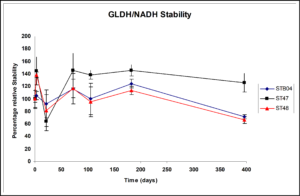
3 stabiliser formulations were used to determine the long-term stability of the biological components used on the sensor surface. One formulation shows no significant decrease in activity over 396 days at 37ºC, equivalent to 665 days at room temperature. The unstabilised version lost all activity within 7 days.

Read More
This kit contains 6 double strength stabiliser formulations designed to stabilise the majority of enzymes and antibodies used in the construction of biosensors. These formulations can be scaled up to provide our customers with a reliable source of stabilisers for their varied biosensor applications.
Solution Stability:
The long-term stabilization of anti-PSA antibodies immobilized onto magnetic beads in the presence and absence of stabilisers
The conjugated anti-PSA antibody shows good stability for 3 months at 32oC in the presence of stabilisers. The unstabilised version lost all activity by month 1.
Bioconjugation and stabilisation of biomolecules in biosensors
Selected Publications:
Electrochemical detection of urinary microRNAs via sulfonamide-bound antisense hybridisation
Microfabricated glucose biosensor for culture well operation